
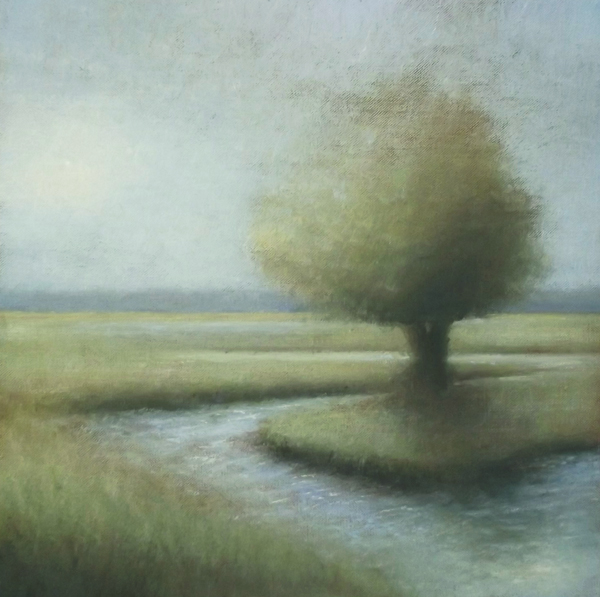
Seems to Be by Marc Civitarese 45″x45″; oil and wax on linen
West Branch Gallery is pleased to announce the publication of a catalog of Marc Civitarese’s paintings to accompany the exhibition “Subtle, Not Subtle” on view through June 5, 2015. What follows is an essay by Ric Kasini Kadour about Civitarese’s artwork that appears in the catalog.
The Emotional Power of Nature
Paintings of Marc Civitarese
by Ric Kasini Kadour
In this collection of paintings, Marc Civitarese gives us intimate images of ocean waves and glowing pictures of New England marshland. He works in the landscape tradition. His paintings concern man’s relationship to nature and spirituality. With soft blues and easy greens, the pictures play with the melodious relations of water, land, and an assortment of grasses, reeds, and low-lying brush that holds the two together.
Landscape paintings are supposed to be easy. They have a simple job: to show us some mountains or trees or rivers; either what is there or what is imagined to be there in a coherent composition that brings the sky and the surface of the earth into harmony. Over time, landscape paintings have been contrivances for everything from allegorical storytelling to Taoist meditation. The experience of the 19th century Hudson River School shapes the tradition of painting in America. Artists like Thomas Cole, Asher Durand, and Frederic Edwin Church painted epic landscapes as a way of sharing the awesome, natural beauty they experienced. This veni, vidi, vici approach to painting the land continues to this day in American art, but Modernism shifted the artist’s purpose from conquering and capturing the beauty of the natural world and towards an exposition of the artist’s personal experience of the land. In contemporary landscape painting, beauty is not found in the land but in our experience of it.
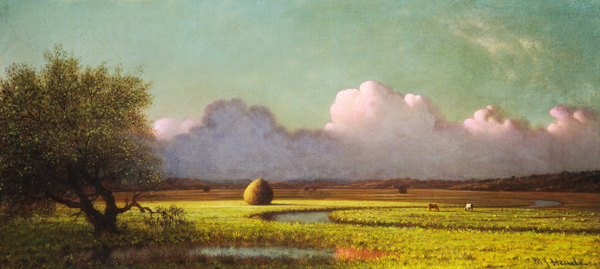
Sunlight and Shadow: The Newbury Marshes by Martin Johnson Heade
12″x26.5″; oil on canvas; c. 1871-1875
This distinction, which is so important to understanding Civitarese’s approach to painting, becomes evident when we compare the painting Seems to Be with the painting Sunlight and Shadow: The Newbury Marshes by Martin Johnson Heade (1819-1904). The subjects of these paintings, while not the same location, are essentially the same: a single tree stands in a marsh. A river snakes through the herbaceous land as a delicate sky hangs in the distance. Working in a typical Hudson River School style, certain details in Heade’s painting crystallize to convey a sense of veracity to the viewer. Cows graze in a field. Across a small stream stands a bale of hay. Discreet brush strokes form reeds of grass or leaves on a tree. These details are instructing the viewer on how the land is and how the land is used. The emotive value of Heade’s painting comes from the movement of mauve light across the clouds, the long reach of the hay bale’s shadow, and other plays of sunlight and shadow which coalesce in the painting to give the viewer a sense of reverence and awe that the Hudson River School is so well known for.
Civitarese’s painting takes a different approach. Where Heade’s painting is a visual record of a place for a viewer who many never experience or see another picture of marshlands, Civitarese paints with the knowledge that the viewer is not relying on him to give an accurate, realistic, informative picture of the marsh. A number of visual cues tell the viewer the artist is attempting to convey a deeply personal experience of the land. First, the perspective is unnatural; as if the viewer is hovering just a little above the land. Second, the elements of the scene are distilled to simple forms. The leaves of the tree are soft, expressive brush strokes that fade into the sky. The reeds and grasses are as airy as the sky, as if the entire scene is a dream or an emerging memory. Like Heade, Civitarese uses light and shadow to evoke emotions but rather than underscoring the dramatic nature of the moment, light gently touches the tips of the rippling water and soothingly blows against the clouds and the tree. Both of these paintings are meant to manifest reverence, but Seems to Be is invoking the reverence that comes from introspection and meditation. The drama is not in the awesomeness of the scene but in the spiritual stillness of the moment.
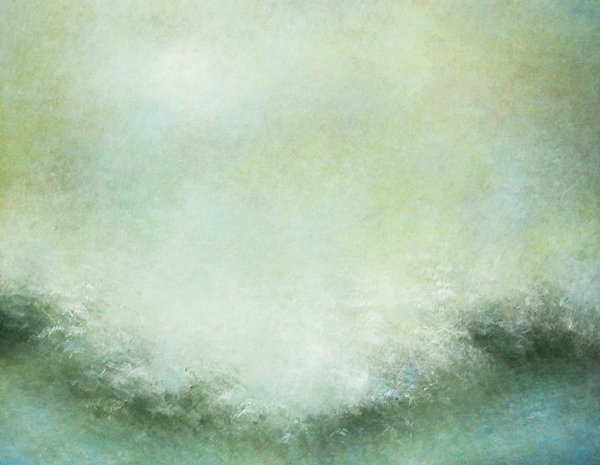
Wash Over Me by Marc Civitarese 35″x45″; oil and wax on linen
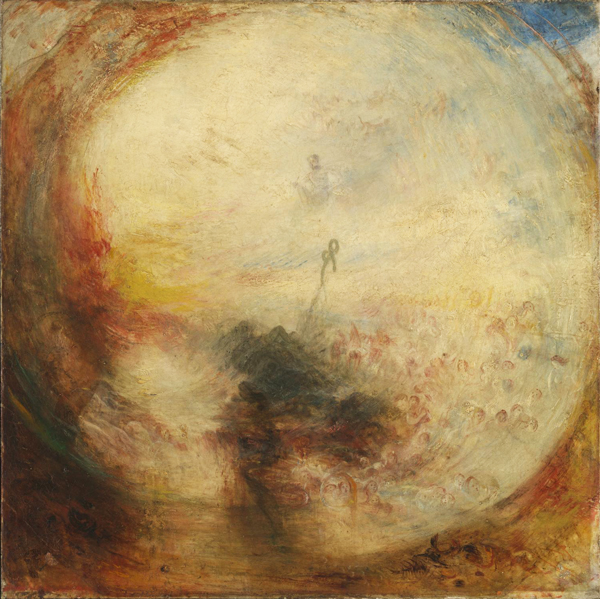
Light and Colour (Goethe’s Theory) – The Morning after the Deluge – Moses Writing the Book of Genesis by J.M.W. Turner 30.9″x30.9″; oil on canvas; 1843
Civitarese’s ability to distill a scene into an expressive moment of reflection is even more remarkable in his series of wave paintings. Unlike a pastoral setting, the ocean is always moving. The force of water crashing into itself, of tides moving in and out, creates an enormous amount of energy and motion. Civitarese’s paintings are further complicated by the fact that the perspective of the viewer is from underneath the water. Wash Over Me reads almost like pure abstraction, but may be familiar to anyone who tried to surface in choppy water wearing a scuba mask on a sunny day. The darkness of the underwater world gives way to the powerful sun that reaches into the water as if the hand of God is pulling the viewer up. While they may not appear that way, Wash Over Me and Civitarese’s other paintings of waves are more realistic than his marsh paintings and are akin to J. M. W. Turner’s expressive renderings of dramatic weather. Turner employed theories he found in Johann Wolfgang Von Goethe’s book, Theory of Colors (1810), and his paintings take on the technical challenge of rendering light and color in a manner that generates the psychological results Goethe’s theories suggest they would produce, that is, producing emotional complexity by contrasting colors that evoke buoyant feelings with colors that evoke melancholy, etc. To the 19th century viewer, these were radical depictions of the sky. Civitarese’s paintings, by contrast, are informed by a sense of minimal and monochrome painting. The texture of the painting’s surface and subtle nuance in color variations allow the seemingly monochromatic paintings to tremble with energy and motion. Civitarese is not painting the waves. He is painting the feeling of being under the waves, the terror of being beaten by them, and the joy of rising above them.
In this sense, Civitarese’s paintings of waves and marshlands are not about their respective subjects. They are about the men and women who see the paintings, who join with the artist in introspection. And he rewards those viewers with stillness and joy and a deeper understanding of the emotional power of nature.
CATALOG AVAILABLE
From the exhibition: “SUBTLE, NOT SUBTLE”
“Subtle, Not Subtle: Evocative Nuance” focuses on painting and sculpture by Marc Civitarese, Janis Pozzi-Johnson, Jonathan Prince, and Helen Shulman. Their work displays a delicate complexity that is easily overlooked by the casual viewer.
READ MORE ABOUT THE EXHIBITION
ABOUT MARC CIVITARESE
Marc Civitarese holds an MFA from Tufts University/School of the Museum of Fine Arts. Since 1993, he has exhibited in solo, two-person, three-person and group exhibitions in New England, New York, Georgia, Florida and the Midwest. The Copley Society of Boston twice awarded him the Juror’s Choice in Painting, as well as the Pearl Art and Craft Award in 1999. His work is in the collection of The Bellagio in Las Vegas, Beth Israel Hospital in Boston, Fidelity Investments, Corporacion Geo in Mexico City and in private collections in the United States and abroad. Marc lives and works in Western Massachusetts.