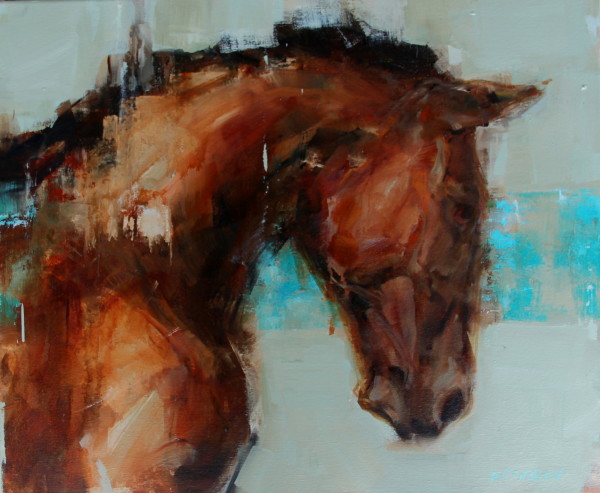
Blue Horse by Georganna Lenssen, Oil on Canvas, 20″ x 24″
Every professional artist has a recognizable signature. For Georganna Lenssen, it is her thick, sculpted layering of color. Her paintings are textural and energetic, alive and dynamic, almost three-dimensional. Whether one is viewing her delectable Pink Rose or her powerful, yet graceful White Horse, Lenssen’s paintings are distinctive in their colorful energy. Her paintings wake you up, reminding you to pay attention to the world.
Much of Lenssen’s work is done en plein air. “Nature offers so many surprises, irregularities and asymmetries that enhance and inform my work,” she said. Some of her more recent oil paintings are of industrial settings; abandoned buildings and building sites, like Lime Quarry, and Wilmington Lot, both oil on board, 12 x 24 inches.
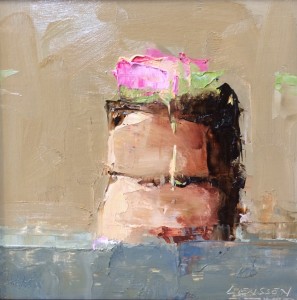
Pink Rose, Oil on Canvas, 10″ x 10″
Lenssen starts by drawing on the canvas, and then builds the painting up with thin layers of paint, often transparent. “I like painting in reaction to a new site. Spending sometimes hours and days in a single location adds an entirely different dimension. I develop history with a location, watching atmosphere and light envelop and pass throughout the days I am painting there,” Lenssen said.
Even though she spends a lot of time at a single site, the finished painting feels immediate and spontaneous. Lenssen paintings are painterly − you can see the brush strokes boldly splayed across the canvas, as if carved out. “I love the contrast of impasto against transparency,” she said. “Gesture and essence has always been a vein in my work, as well as ambiguity.”
There is nothing ambiguous in Lenssen’s oil paintings though. Whether it be her still lifes, like Purple With Vase, framed at 7 x 7 inches, or her landscapes like Once there was a Farm Horse, 24 x 20 inches, Lenssen’s paintings are singular and recognizable in their subject. The way she boldly applies her paint, as if she has no fear or trepidation, is part of her paintings’ appeal.
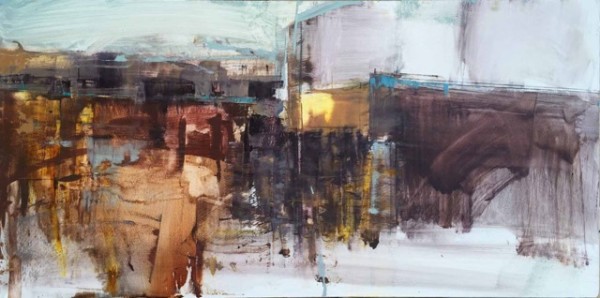
Wilmington, Oil on Panel, 12″ x 24″
And yet, like all artists, she struggles. “One of the biggest challenges I face is my immediate tendency to destroy the work. It’s hard for me to see it objectively,” Lenssen said. “I am working on trying not to judge my work so quickly and so harshly, although I think that will probably continue as a lifetime struggle. I destroy 80% of what I create before I have had a chance to see it a few days later.”
As well as painting on location, Lenssen also works in her studio in historic Yellow Springs, Pennsylvania. The old building is located on acres of mostly naturalized land. “The grounds are magical, with secluded paths through wooded areas leading to working spring houses which haven’t been touched since the 1700’s. There are streams, bogs, and ruins of a former hospital and spa,” she said.
When painting animals, as in Blue Horse, 20 x 24 inches, there is definitely a feral quality infused in the work. These paintings are, like her landscapes and still lifes, rich in color and luminosity. Lenssen loves the work of Cy Twombly and the drawings of Walter Pichler. She is also drawn to the simplest of things, like watching the changing patterns rain creates on the windshield of her car, or watching the fracturing of light and the deconstruction of objects through the water. “I am constantly stopping on the road and taking hundreds of photographs of the rain and the world it creates on the glass.”
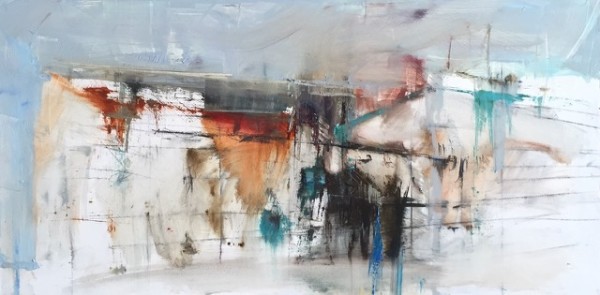
Lime Quarry, Oil on Panel, 12″ x 24″
A graduate of the Pennsylvania Academy of Fine Arts, Lenssen has exhibited for the last 15 years in different galleries, including West Branch Gallery. She has taught at Wayne Art Center in Wayne, Pennsylvania, led workshops at Historic Yellow Springs Studios, as well as teaching privately. With all that, she still manages to paint every day. “I love to continue very late into the night when I can feel the quiet of the night. My studio is a very private place. When I go into my studio, I have a ritual I do which signifies that I am entering a different realm, leaving everyday baggage at the door.” Make no mistake, being an artist is exacting work. Every single day.