
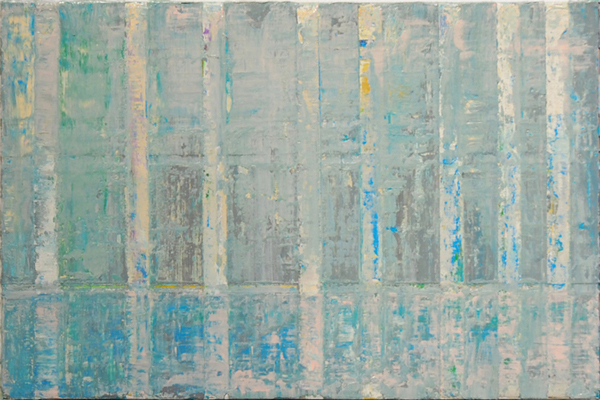
Les Nouveaux Vestiges No. 19 by Richard Cloutier 12″x18″, acrylic on panel
Through April 19, 2026
Endless Beginnings: Non-Representational Art Today
“Endless Beginnings” closes on April 19, 2026 in the South Gallery of West Branch Gallery & Sculpture Park. In earlier posts, we wrote about Tom Cullins finding abstraction in the natural world (here); how Val Rossman and Idoline Duke continue a tradition started by early Modern abstract artists that use color and shape as a way of expressing ideas about the world in which we live (here); how Lois Eby paints motion, energy, and music (here) and how Richard Cloutier offers viewers “hypothetical architectures” that convey the emotions of space (here).
In the exhibition “Endless Beginnings: Non-representational Art Today”, West Branch Gallery explores the art of eleven gallery artists who make non-representational paintings and sculpture.
In Summer 1950, a writer for The New Yorker paid a visit to Jackson Pollock’s “big, gaunt, white clapboard, Ulysses S. Grant-period structure in the fishing hamlet of The Springs” on Long Island, New York and chatted with the artist about his “uncommonly abstract” paintings. “There was a reviewer a while back who wrote that my pictures didn’t have any beginning or any end,” recalled the artist. “He didn’t mean it as a compliment, but it was. It was a fine compliment. Only he didn’t know it.” Pollock came from a world where paintings were representational-primarily pictures of people and places. He studied under the rigidly realist Thomas Hart Benton at the Art Students League who, according to Pollock, “drove his kind of realism so hard I bounced right into non-objective painting.”
Abstraction, non-objective and non-representational art have become the dominant visual language in contemporary art and yet, to many people, these works remain a mystery.
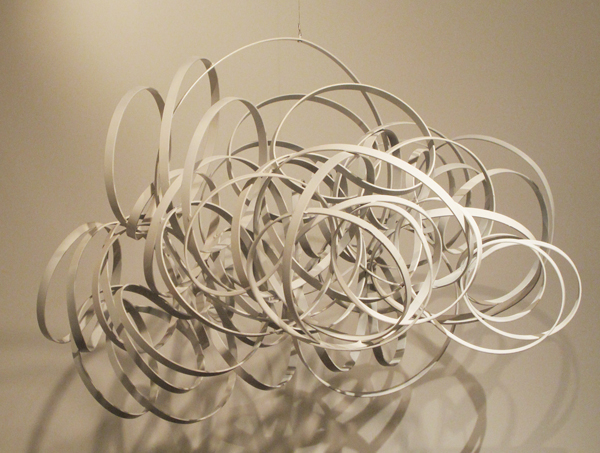
Cloud by Charles Orme 24″x24″x22″, painted steel
“Endless Beginnings” is anchored by “The Quarry Series” by Tom Cullins in which the artist paints the jagged lines of the Barre granite quarry and the water’s reflection on it. In doing so, Cullins reveals a natural abstraction found in the man-shaped landscape. In his wood collage paintings, Duncan Johnson finds pattern and rhythm in the juxtaposition of old wood that he refines. A ribbon of steel dances, curves, and comes together in the shape of Cloud by Charles Orme. Giovanna Cecchetti uses paint, paper, and thread to make her ethereal Embedded Blessing. Idoline Duke uses lines and color to capture the palette of a summer evening. Lois Eby improvises brush strokes with black ink and red acrylic. Richard Cloutier explores the texture of paint on wood through color fields and lines. Val Rossman shows the fragmented quality of contemporary life with an erratic pattern of colors. Christopher Curtis intervenes on a boulder to reveal a hidden city and to engage us in a dialogue with stone. Clark Derbes makes multi-colored, polygonal sculptures using reclaimed wood and paint as a way of exploring color, shape, and pattern. Sarah Horne contrasts gestural color painting with the natural dripping of paint in an attempt to translate her experiences into marks on paper.
These artists use a variety of visual strategies to convey ideas and emotions to the viewer. Unlike art that is about people, places, and things-moments fixed in time-these artworks don’t necessarily have a beginning or an end. Instead, they possess endless possible ways to approach art and develop a relationship to it.
The exhibition is part of West Branch Gallery & Sculpture Park’s expanded exhibition program in 2015. The new program will feature a series of exhibitions that allow for a deeper reflection and interpretation of gallery artists and sculptors. “Endless Beginnings” is curated by Ric Kasini Kadour and West Branch partner Tari Swenson.