
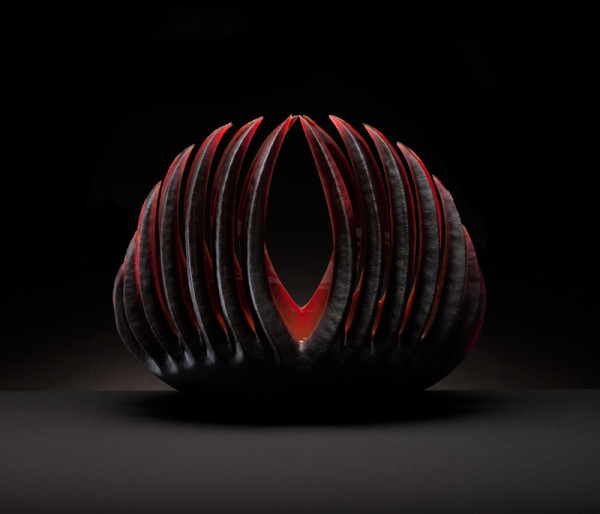
Red Lotus by Paul Schwieder, Carved Glass, 12″ x 15″ x 9″
Red is the most dominant and perhaps even the most dynamic of colors. The color is linked to so many symbols and emotions; one can see why it is often said to be the most exciting of all colors.
In Royal Heraldry, red denotes courage and zeal, while in Catholicism red is the symbol for fire and blood, as well as charity and generous sacrifice. In Hinduism, red is used for auspicious occasions like birth and marriage and is thought to have the capacity to destroy evil. Sir Isaac Newton called the key of C red, while the composer Rimsky-Korsakoff thought the key of F sharp was red.
There is the red light district where red is in abundance: lust, heat, desire, passion, longing, danger, rage, action, violence. The color red is linked with the most primitive of our emotions. Psychological studies show that red can cause physical effects like restlessness, nervous energy, high blood pressure, heightened libido, and even increased confidence.
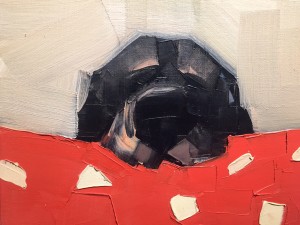
Alarm Clock Study #3 by Rebecca Kinkead, Oil on Linen, 10″ x 12″
All colors have personality and clearly red is extroverted, strong-willed, and determined. However, there are two sides to this personality: focused and persistent can easily morph into irascible and stubborn. You could be called a ‘red herring’ and still get the ‘red carpet treatment.’ You might be ‘in the red’ while ‘painting the town red.’
And yet, if someone says “red,” everyone has a different shade of red in their mind. Is it the red of a tomato, or a cherry, red hair, the Coca-Cola sign, Warhol’s soup can, Rothko’s White Over Red painting, the chair in Picasso’s The Dream, or the red of Matisse’s Red Studio?
Red has many names. It can be scarlet, crimson, vermillion, carmine, maroon, burgundy, ruby, rose madder, rouge, brick, blood red, blush, fire engine red, cinnabar, russet, rust, Venetian red, flame red, and Indian red.
There are so many hues, tones, shades and tints of red, that defining the exact color in a work of art is difficult. In Paul Schwieder’s sculpture, Red Lotus, the glass is infused on the outside in a deep ruby red, while on the inside it is flame red. With Alarm Clock Study #3, the oil on linen painting by Rebecca Kinkead, the black dog rests his chin on a blanket the color of rose. Still another red is in Bruce White’s powder-coated aluminum sculpture, Solar Event; a deep rich burgundy morphing into the silver. And Val Rossman’s It Only Got Better, acrylic on aluminum, has different reds; fire engine red and scarlet alongside lavender, blue and black, popping the reds even more.
Examining the color red through history, blood and death were usually involved. The cochineal or scale insect is native to Mexico and cultivated on cacti, like the prickly pear. Producing red coloring from cochineals is a grim industry. The insect must be female, and pregnant. Thrown alive into huge vats, the pregnant insects are churned furiously, leaving behind their much prized crimson red blood. Ancient Egyptians imported cochineal by camel from Persia and Mesopotamia, and from Europe to China. In the late 1500’s, 176,400 pounds of red from the cochineal was shipped to Spain!
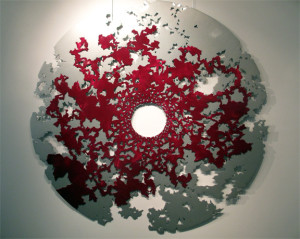
Solar Event by Bruce White, Power Coated Aluminum, 42.25″ x 42.25″ x .5″
Another prized insect is the kermes insect, the Indo-European cousin of the cochineal, where the word carmine comes from. Kermes was the most expensive dye in Europe at that time. Cloth in the Middle East dyed with kermes was called scarlet. Insect blood, throughout history, has been used to paint lips and rouge cheeks.
Madder, a plant root used for dyes, was much cheaper but it tended to be more brown than the kermes rich crimson. An extract of carmine, made by crushing cochineal and other scale insects which feed on the sap of live oak trees, was also called kermes. This was used from the Middle Ages until the 19th century to make crimson dye. Now it is used as a coloring for yoghurt and other food products, like making ham a deeper red.
The mineral cinnabar, the ore of mercury, is the source of the color vermilion. In Roman times, most cinnabar came from mines at Almadén in Spain. Mercury is highly toxic, and working in the mines was often a death sentence for the miners, most of whom were prisoners and slaves. The Romans loved raw cinnabar but medieval artists preferred to mix the refined mercury with sulfur. This pigment was used in the painting of Chinese lacquerware and in the coloring of the murals of Pompeii. Cinnabar’s manufactured form is vermilion, which is resistant to blackening or fading. Today vermillion, because of its cost and toxicity, is often replaced by the cadmium reds which have a comparable color and opacity.
Originally, crimson tones were made with animal or vegetables: kermes, grain, madder, dragon’s blood, brazilwood, cochineal and carmine. Now alizarin replaces them all. Alizarin manufacture requires superlative skill to refine it from the madder root plant. It must be absolutely free from the contamination of iron. Alizarin red is much more powerful in tinting strength than the weak madders. The highest grade has a brilliant rosy tone in its dry state. Indian red has a bluish tint; light red, scarlet; Mars red a maroon tint. Spanish red has a bluish tone while Venetian red has a scarlet shade.
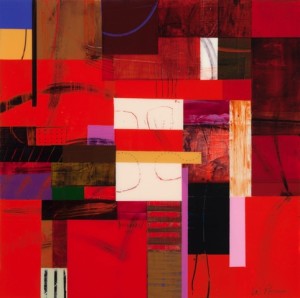
It Only Got Better by Val Rossman, Acrylic on Aluminum, 12″ x 12″
There are always two sides to red. Red’s energy has a strong influence on the growth of plants, and yet cherry coke is made with the red additive E120. Too much red can make you lose your temper. You might feel agitated, even angry and oppressed. But too little red can make you feel lethargic and cautious. Psychologists suggest adding green, reds opposite, to calm your emotions. And to get rid of exhaustion, add more red.
Cupid or the Devil – it’s all red.
so much depends
upon
a red wheel
barrow
glazed with rain
water
beside the white
chickens.
- “The Red Wheelbarrow” by William Carlos Williams