
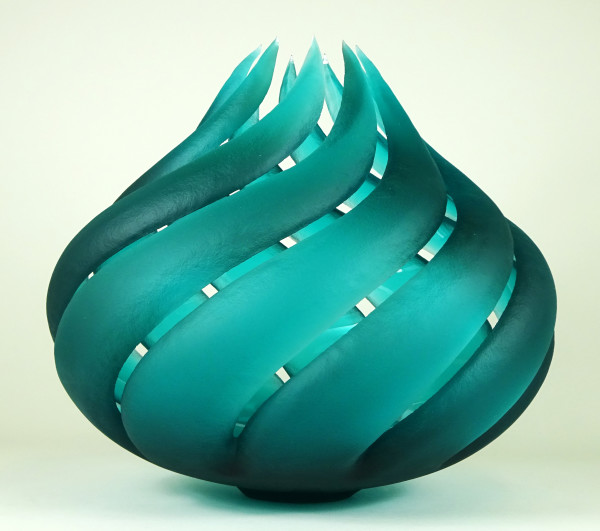
Turquoise Bulb by Paul Schwieder, Glass, 13″ x 14″ x 14″
Every month, we will be riffing on a different color. This month the color is blue, lending cool contemplation to a hot month.
Artists have been making the color blue for centuries. In 1508, Dürer complained about the price of a pound of ultramarine blue at 100 florins. Today the paint derived from a Renaissance recipe using stones from Afghanistan costs $4000 for the same amount. The intense blue from lapis lazuli has been mined in Afghanistan for 3000 years. During the Middle Ages, blue was the color of garments of the powerful and wealthy in Europe, and always the Virgin Mary’s robes. The radiant ultramarine blue of Fra Fillipo Lippi’s Coronation of the Virgin is still, 500 years later, breathtaking. Today blue denotes serious business practices; blue suits and ties and Democrats.
Van Gogh wrote, “To exaggerate the fairness of hair, I make a plain background of the richest, intensest blue that I can contrive, and by this simple combination of the bright head against the rich blue background, I get a mysterious effect, like a star in the depths of an azure sky. There is no blue without yellow and without orange.” Look at his Starry Night with the swirling yellow and orange sun; a prime example of this dynamic.
Early in his career at the beginning of the Twentieth Century, a depressed Picasso painted through his blue period of three years using a monochromatic palette of blue and blue-green. The theme of these paintings was the desolation of social outsiders; beggars, circus people and the poor, such as The Old Guitarist (1903) and The Frugal Repast (1904). Matisse’s famous cut-outs, The Blue Nudes (1952), were made with his ultramarine gouache-painted paper, because for him, blue signified distance and volume.
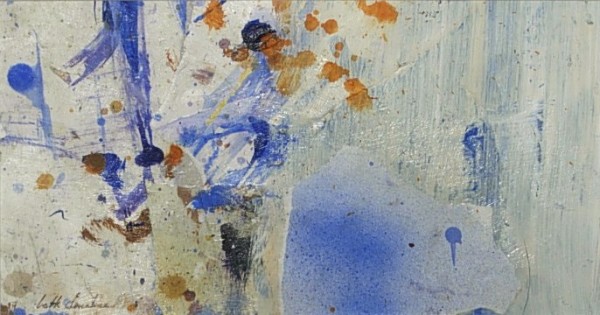
American Zen #051 by Beth Donahue, Mixed Media on Hand-made Paper, 17″ x 25″
The Blue Rider Group, Der Blaue Reiter, was founded in 1909 by Russian emigrant artists; Wassily Kandinsky, Alexej von Jawlensky, Marianne von Werefkin, and German artists; Franz Marc, August Macke and Gabriele Münter. The movement was fundamental to Expressionism and lasted until 1914. Wassily Kandinsky’s cover art for the Der Blaue Reiter almanac (1912) depicts a blue horse and rider. For Kandinsky, blue was the color of spirituality - the dark blues, like indigo, symbolizing wisdom and spiritual realization.
Indeed, blue is calming, cools you down, and is said to aid intuition. Blue is considered trustworthy and dependable, appealing equally to men and women. “Blue color is everlastingly appointed by the deity to be a source of delight.” John Ruskin, British art critic, (1846).
The shades of blue created today are mind-boggling. There is air force blue and baby blue, blue-gray and blue-green, Caribbean amber and Carolina blue, Persian and Prussian blue, azure, cerulean, cobalt, cornflower, cyan, midnight and navy blue, electric blue, indigo, periwinkle, phthalo and powder blue, royal blue, teal and turquoise, violet-blue, indanthrone, manganese and ultramarine blue, just to name a few.
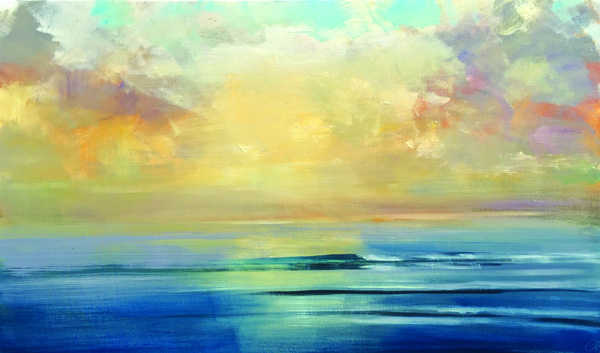
Waiting for the Sun by Craig Mooney, Oil on Canvas, 36″ x 60″
Of course in landscape paintings you will find many shades of blue. There is the blue sky and the deep blue sea. In a sea of wildflowers there are blue lobelia and blue cornflower. Blue is a cool color in landscape design, bringing a soothing element to the garden. Blue plants visually recede, helping to make a small space appear larger. “To any white body receiving the light from the sun, or the air, the shadows will be of a bluish cast.” Leonardo da Vinci
In ceramics, cobalt oxide, copper carbonate, and iron oxide are used to produce the blue glazes when mixed with other ingredients. Raoul Dufy, the French Fauvist painter, said, “Blue is the only color which maintains its own character in all its tones. It will always stay blue. Yellow is blackened in its shades and fades away when lightened. Red, when darkened, becomes brown and when diluted with white, it is no longer red but pink.”
People are often more productive and contemplative in an environment of blue. There is The Blue Mosque of Cairo in Egypt, The Blue Mosque of Yerevan in Armenia, Sultan Ahmed Mosque in Istanbul, Turkey, and The Blue Mosque of Tabriz in Iran. Blue is a sacred color in Iran symbolizing paradise. In India, the god Krishna has blue skin, and in Greece, blue is worn to ward off the evil eye.
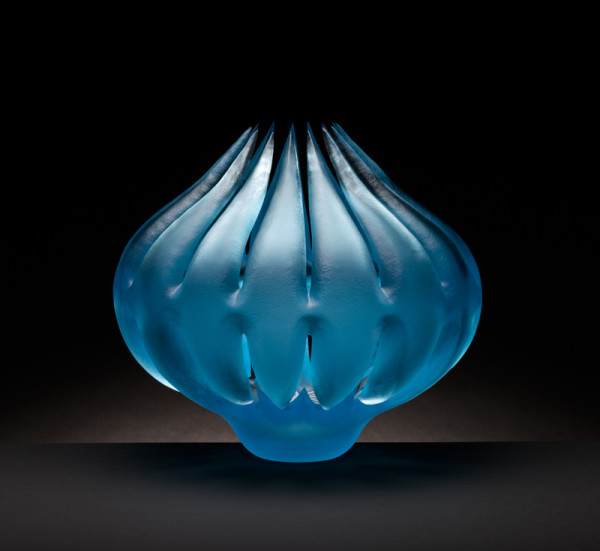
Copper Blue Star by Paul Schwieder, Glass, 14″ x 15″ x 15″
Paul Schwieder’s sculptures, Turquoise Bulb and Copper Blue Star, are carved out of blown glass. To achieve their luminescent blue color, he uses a homemade recipe, which includes copper. He brings the glass mixture up to the correct viscosity in a small glass shop in eastern Quebec, BabaJaga Glassworks. “The process isn’t cheap, approximately $5000 per melt (about six pieces) and very tricky,” Schwieder said. “The wrong atmosphere in the melting chamber, a small miscalculation in chemicals, a little too long or short melt time- all of these can lead to creating a big pot full of garbage.” Fortunately, his sculptures at West Branch are organically beautiful.
Finally, did you know that mosquitoes are attracted to the color blue twice as often as to any other color? Yikes!
“Blue! ‘Tis the life of heaven,-the domain
Of Cynthia,-the wide palace of the sun,-
The tent of Hesperus, and all his train,-
The bosomer of clouds, gold, gray, and dun.
Blue! ‘Tis the life of waters: — Ocean
And all its vassal streams, pools numberless,
May rage, and foam, and fret, but never can
Subside, if not to dark-blue nativeness.
Blue! Gentle cousin of the forest-green,
Married to green in all the sweetest flowers,-
Forget-me-not,-the Blue bell,-and, that Queen
Of secrecy, the Violet: what strange powers
Hast thou, as a mere shadow! But how great,
When in an Eye thou art alive with fate!”
- John Keats